Valentino Ivan Wilson
Longboard Leaper
Project Description:
This group project tasked us with creating a new to market product, that would serve as a solution for a commonly encountered problem. My group consisted of four students and my role in the project, aside from normal group member tasks, was creating all CAD models and GD&T engineering drawings for the project. I was also in charge of 3D printing all individual parts while assembly of the final product was completed as a group.
Design Procedure:
Brainstorming for the project utilized a problem-based approach with a focus on creating a product with a human-centered design. Initial brainstorming sessions consisted of identifying possible problems that needed solutions in our daily lives as college students. These brainstorming sessions were driven by the ‘Post-It’ method. We ultimately decided to create a product that would solve the issue of effective longboard jumping. Due to longboards having a longer and heavier design, they have an increasing difficulty clearing obstacles that are more than two inches off the ground. We wanted to create a mechanism that would allow users to seamlessly maneuver over curbs without risking injury from hitting the curb and falling. Our second round of brainstorming sessions centered around product design and consisted of evaluating each design sketch in question using a SWOT analysis until a final design was chosen. CAD prototypes for each iteration of our product design were created in PTC Creo. Additionally, GD&T engineering drawings for the final assembly and its individual components were also created. To culminate the project, a final working prototype was fabricated and assembled by hand. Throughout the semester we conducted design and prototype review presentations and created a set of final deliverable documents consisting of Design Specification, Design of Experiments (DOE), BOM, and Design for Assembly (DFA) documents. A BOM was created to document all purchased parts and ensure our $200 budget was not surpassed. It was also used to document how each component of our final prototype would be manufactured. The progress of the project throughout the semester was recorded through the usage of a GANTT chart.
Design Description:
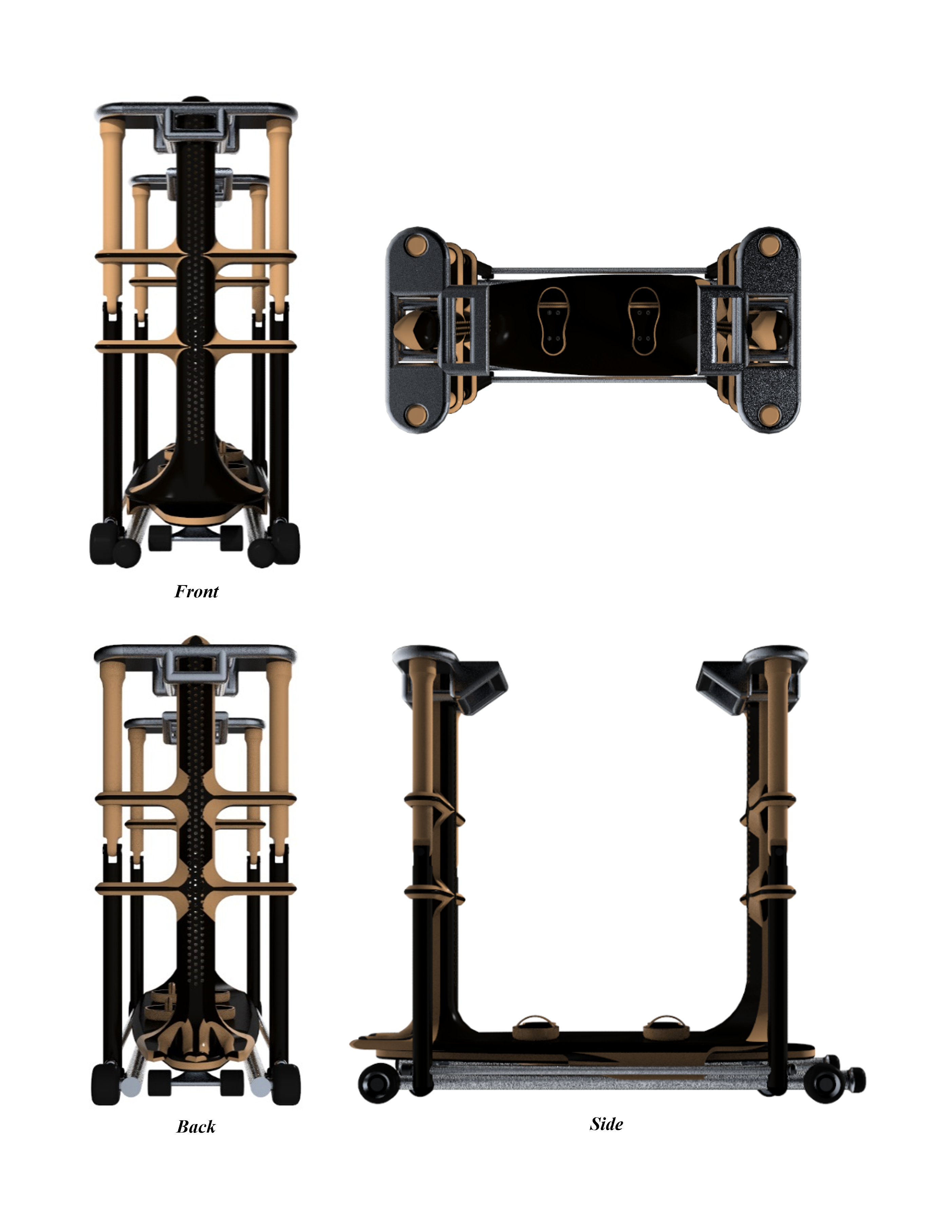
Our design consisted of a large mechanism that would retrofit an existing longboard. The mechanism would allow the user to lift themselves and the board to a specified height and then utilize the contact made between the mechanism and the curb to propel them up and over the curb safely. The initial inspiration for our design came from the biomechanics associated with a skateboard trick called ‘the Ollie’. We analyzed this trick and attempted to recreate its motion. The ollie consists of the skateboarder rapidly kicking their back leg into the backend of the board thus causing the front-end of the board to elevate. Upon frontend elevation, the skateboarder then pushes their front leg downwards in order to make the board horizontal while midair. Together, these motions create a jumping movement that we wanted our design to replicate. Our mechanism consisted of 4 components: the board sleeve, bumper, arms, and handles. The board sleeve was attached directly to the longboard and consisted of two vertical bars with slots for the arms. The arms were slotted through the vertical poles of the board sleeve to maintain the 180-degree orientation of their knee joints. The top-end of the arms were attached to the handles and their bottom-ends were attached to the bumper. The user would be required to strap at least one of their feet into the board sleeve to achieve synchronous elevation of both ends of the longboard during the jump. Upon approaching a curb, the user would push down on the handles to elevate the board. Upon reaching the desired height, the bumper would then contact the curb causing the arms to bend at their knee joints and propel the rider forward. The system would then be reset by pulling the handles upwards causing the arms to reset back to their 180-degree orientation within the board sleeve slots.
We encountered many issues throughout this project. Initially, we focused on designing a mechanism that would strike the ground under the longboard, however, we eventually realized that this type of mechanism would not be feasible. We, therefore, diverted our efforts towards creating the mechanism aforementioned that would harness the energy created by the contact made between the board and the curb to gain the necessary elevation and push to complete the jump.

University:
University of Illinois at Urbana-Champaign
Program:
B.S. in Mechanical Science and Engineering
Course:
ME 270: Design for Manufacturability
Experience Level:
Sophomore Year
Project Duration:
3 Months

Valentino Ivan Wilson
Chicago, IL
 Valentino Ivan Wilson