Valentino Ivan Wilson
Soap Dispenser
Project Description:
This group project tasked us with creating a new product incorporating the design principles learned throughout the introductory CAD course. Our only design constraint for the project indicated that the product needed to be small in size and contain sub-assemblies. My group consisted of three students and my role in the project, aside from normal group member tasks, was creating the CAD model and all GD&T ANSI engineering drawings.
Design Procedure:
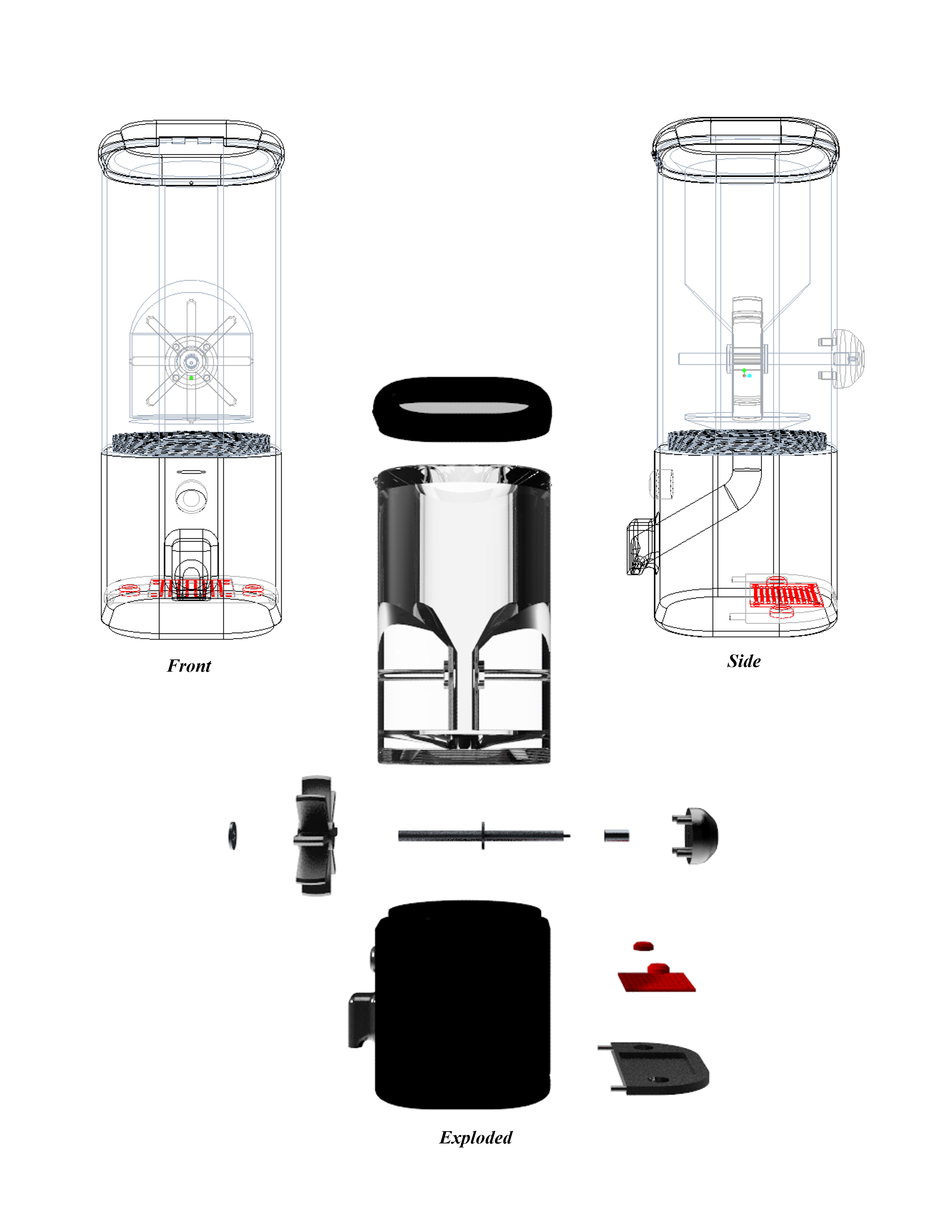
Brainstorming for this project utilized a problem-based approach, focusing our efforts on creating a product with a human-centered design. We identified a product that humans use every day and that could be redesigned to solve a commonly faced problem. We decided that humans often either use too little or too much soap when washing their hands, face, hair, and/or bodies. We set out to create a soap dispenser utilizing mechanical components that would consistently dispense the same amount of soap with each use. Additionally, we wanted our design to be capable of adjusting the amount of soap dispensed per application, whether that be for hand, face, hair, or body washing. We realized that each application would require different amounts of soap, so we wanted to account for that in our design. The ideation stage of our project consisted of each team member creating initial design sketches that were evaluated using Pugh Convergence Matrices. We evaluated each design on the criteria: compatible size, durability, resistance to water, simplistic design, and ease of usage. Once our final design was chosen, we created a Product Design Specification addressing each of the 29 specifications of interest. Our CAD prototype was created in PTC Creo as this was the CAD program taught in the course. Part models were created for each part in the product assembly. A final assembly model with exploded views, Bill of Materials (BOM), and a full set of ANSI engineering drawings were created as well. No physical prototype for this project was required.
Design Description:
Our soap dispenser design consisted of three attachments: the base, main compartment, and lid. Located in the main compartment was a rotating wheel (divided into eight slots of equal volume) which would control the amount of soap dispensed with each use. The wheel’s diameter extended the internal width of the main compartment, creating a seal within. Soap was to be loaded into the top half of the main compartment, exposing the upper half of the wheel to the soap and allowing half of the wheel’s slots to be filled. Attached to the wheel shaft was a DC stepper motor which was controlled by an Arduino located in the dispenser base. With each press of the dispenser button, the motor would rotate the wheel 45 degrees, thus releasing the soap from the wheel compartments into the nozzle below. Other angle options included 30, 60, and 90 degrees which could be chosen by rotating the button itself to the desired setting. With this soap dispenser, the user would maximize the lifetime of their soap bottle and ultimately allow for consistent cleanliness of their hands, face, hair, and/or body.

University:
University of Illinois at Urbana-Champaign
Program:
B.S. in Mechanical Science and Engineering
Course:
ME 170: Introduction to Computer Aided Design
Experience Level:
Freshman Year
Project Duration:
3 Months

Valentino Ivan Wilson
Chicago, IL
 Valentino Ivan Wilson